Subscribe to our newsletter

Saturday, 8 August 2015

The Spherical Sun Power Generator


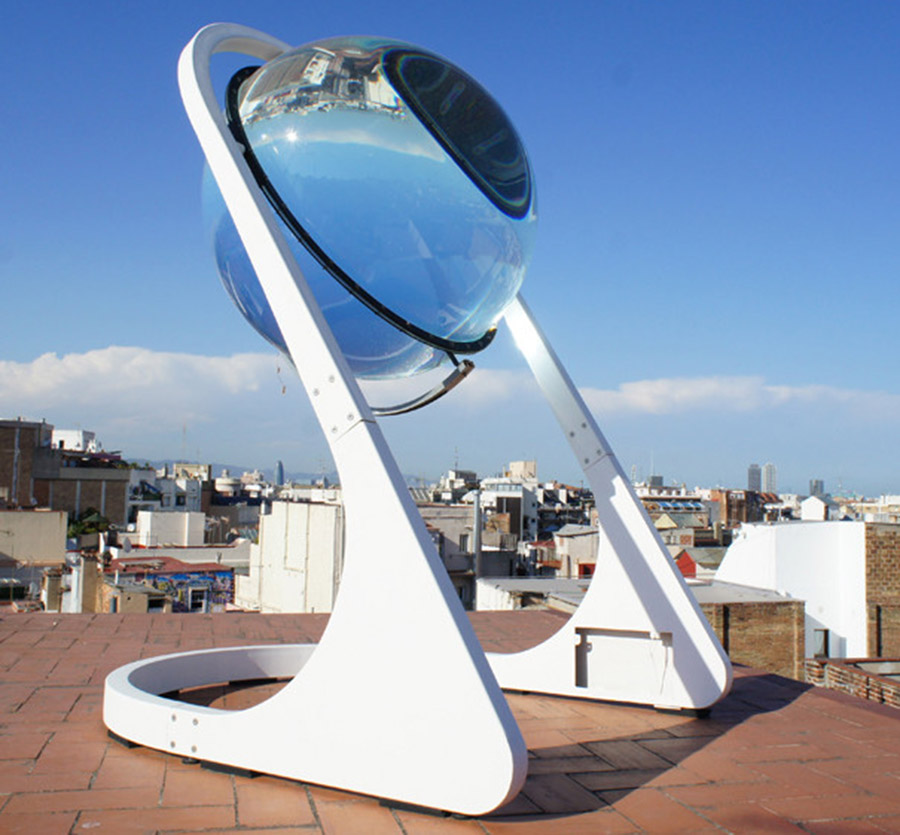
German Architect Andre Broessel has come with a new invention he calls “The Spherical Sun Power Generator”. He believes it has the ability to “squeeze more juice out of the sun”, even during the night hours and in low-light regions. He created a spherical sun power generator prototype called the beta.ray. His technology will combine spherical geometry principles with a dual axis tracking system, allowing twice the yield of a conventional solar panel in a much smaller surface area. 

The futuristic design is fully rotational and is suitable for inclined surfaces, walls of buildings, and anywhere with access to the sky. It can even be used as an electric car charging station. …“The beta.ray comes with a hybrid collector to convert daily electricity and thermal energy at the same time. While reducing the silicon cell area to 25% with the equivalent power output by using our ultra transmission Ball Lens point focusing concentrator, it operates at efficiency levels of nearly 57% in hybrid mode.

At nighttime the Ball Lens can transform into a high-power lamp to illuminate your location, simply by using a few LED’s. The station is designed for off grid conditions as well as to supplement buildings’ consumption of electricity and thermal circuits like hot water.” See diagram below.


The modular collector system charges and stores energy during daylight hours and can even collect energy from the moon during night hours:
See more pictures.


Friday, 7 August 2015

Falling cost of Solar Power Poised to Revolutionize Power Industry


The rapid improvement in the technology and freefall in costs since early 2010 have brought about major transformation in the solar industry. Systems that were completely unaffordable or impractical just two years ago are now cost effective. To put that into perspective, the cost of installing a solar system two years ago and today is not the same. A house that is entirely off the national power grid would have cost $10,000 in 2011. But today the entire installation will can be done for under $5,400.

Product quality is improving too, as customers demand better product with longer warranty. When all these improvements are combined, it is no wonder that solar is making such great leaps forward. For more applications than ever before, solar is the best and most cost effective way to generate electricity. 

The burning question is why has Africans not come to embrace this new form of energy. The source is free and it’s ever reliable. The technology is clean and the product durability is almost one’s lifetime.
Over the coming years, all the signs are that the technology and the industry will continue to evolve at a similar pace. In the next three years, solar will become the cheapest way of generating electricity available. 

We are likely to see solar energy incorporated into more and more everyday objects such as laptop computers, mobile phones – even clothing. Meanwhile, solar energy is going to cause a revolution for large areas of Asia and Africa where entire communities currently have no access to electricity. 

Even large scale solar projects - entire solar power stations, capable of generating many megawatts of electricity, are now becoming feasible. In the United States, United Kingdom, Germany and Mexico, solar photovoltaic power stations are now generating electricity for entire towns. In Spain, new giant thermo-solar power stations have come up with new ways of not only generating electricity during the day, but storing the sun's energy so that it can be used for generating electricity overnight. 

As an easy to use and low carbon energy generator, solar is without equal. The technology is likely to touch every person on the planet in the next 30years to come. Its potential for changing the way we think about energy in the future is huge.

Wednesday, 5 August 2015

Akon Lights Up Nigeria With Solar Initiative


Senegalese-American musician is currently in Nigeria to boost his campaign, aimed at giving African engineers and entrepreneurs the skills needed to develop solar power.

The star previously launched the Akon Lighting Africa initiative with a view of providing electricity to some 600 million Africans, as he recently entered a public-private partnership with various entities across the globe with the promise to help bring energy into millions of homes in Africa
The Akon Lighting Africa’ project includes installation of solar equipment in households as well as the promotion of their energy sufficiency which will allow millions of Africans access to electricity.

The project plans to start delivering village-level solar power to allow people to have access to affordable electricity and equally create massive employment.

The Artist met with Nigerian business men, artistes and politicians to sell his project.

Tuesday, 4 August 2015

Face of Solar Powered Banking


The world of automated banking is taking a new face as it embraces solar automated machines. At the Chennai factory of startup Vortex Engineering, technicians are building ATMs that can work far better in rural areas compared with conventional cash machines. The CEO and director V Vijay Babu said they have installed over 300 solar powered of such machines in India.


According to him, traditional ATMs require about 1,000 watt of power. ATMs are also air conditioned. For air conditioning another 1,500 watt are consumed. In total an ATM needs about 1,800 units of power a month. But solar driven ATMs would consume less than 100 watt. Solar ATMs can do without air conditioning. Therefore solar powered ATMs will need 72 units per month. This will result in saving of 1,728 units per month. If we talk in monetary terms, solar ATMs will save ($2639) every year.

Another important quality of Vortex Gramateller is its built-in biometric capabilities. The literacy rate in rural India is quite low. Assuming most of the customers will be illiterate then the ATM has to function without PIN numbers. These machines will require the fingerprint of the customers as authentication. Vijay explains, “With a predominantly illiterate population in rural India, we decided to address the issue with a simple fingerprint identification for ATMs.

 Once registered with the bank, customers can use either biometric authentication or PIN number approval for cash withdrawal.”

V Vijay Babu claims that Gramateller will also be 20 per cent cheaper than other ATMs.

Solar Powered Floating House


This Solar powered house was designed by Italian architect Giancarlo Zema and produced by EcoFloLife. The 100 square meter residential units are made of up to 98% recycled materials; including the laminate timber and aluminum hull. Skylights, balconies and large windows encircle the dwelling, allowing for efficient lighting and beautiful waterfront views.

A sophisticated system of natural micro-ventilation and air conditioning classifies it as a low-consumption residential habitat. Scroll down for more photos. The units can be positioned along rivers, lakes, bays, atolls and calm sea areas. The interiors are warm and welcoming, and include a living room, dining room, bedroom, kitchen and bathroom. The 12m diameter circular layout can be configured as a house (1 to 4 people), office, lounge bar, restaurant, shop, or exhibition space.Scroll down for more pictures.